About Indian dance

The eight Indian classical dance forms are Manipuri, Bharatanatyam, Kathakali, Kathak, Kuchipudi, Odissi, Mohiniattam and Sattriya. The first three of these are introduced here.
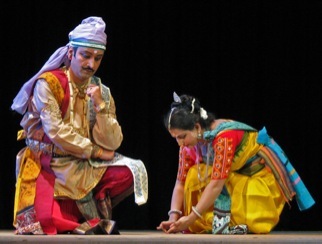
Like the movements of the body and feet, the facial expressions in Manipuri dance should be subtle. The main bases of this dance style are devotion and grace.
Bharatanatyam
Bharatanatyam is an extremely graceful dance from the south Indian state of Tamil Nadu. It is the oldest classical dance form in India.
It follows a precise pattern of seven items beginning with the relatively simple atarippu, the invocation without which a performance cannot begin. Complex dances follow this auspicious start and conclude with a sloka, ie, a sacred Sanskrit verse. Originally, Bharatanatyam was performed solely by devadasis, temple dancers who lived only to serve the deity.
Bharatanatyam is concerned with total physical balance, so as to enable the dancer to move his or her limbs effortlessly. The theme of nayak and nayika (lover and beloved, hero and heroine) is a favourite one. Special poems called padams provide tremendous subject-material for the dancer. Padams tend to be slow-paced, allowing for the full-fledged enactment of emotion.
Kathakali
Kathakali is a dance-drama from the south Indian state of Kerala. Kathakali literally means story (katha) and a dance or performance (kali). The stories are usually from the epic Indian legends Ramayana and Mahabharata. The actors have traditionally been drawn from the Nair community, well-versed in the martial arts of ritual warfare. This has proved a sound background because the training for Kathakali performers is strenuous and extends over 6-10 years.
A normal day of training begins in the early hours of the morning and continues for several hours. The text of the plays as well as the dance sequences and choreography must be memorised, complete with facial expressions, eye movements and hand gestures.
Precision is the key word in Kathakali as the ideas and emotions are all communicated through physical movements. The text of the play is sung in characteristic style known as sopana by two singers who remain behind the actors.
Manipuri
Manipuri dance originates from Manipur, a state in north-eastern India on the border with Myanmar (also known as Burma). The traditional Manipuri dance style embodies delicate, lyrical and graceful movements.
The aim is to make rounded movements and avoid any jerks, sharp edges or straight lines. It is this which gives Manipuri dance its undulating and soft appearance. Of course, behind this outwardly soft impression lies a tough regime of body control.
This page provides an introduction to the various Indian dance styles. Of the eight Indian classical dance styles, the three in which Kaberi has trained are outlined here: Manipuri, Bharatanatyam and Kathakali. The semi-classical Tagore dance form and Indian folk dances are also mentioned.
For more information and references, please see the various entries in Wikipedia. The Wikipedia article on Manipuri dance was initiated by Kaberi in November 2005.
Introduction
Indian classical dances
The semi-classical dance form created by the Nobel prize-winning poet and philosopher Rabindranath Tagore was particularly influenced by these three Indian classical dance styles. However, he was also influenced by other dance styles from all over the world. There is very limited literature on the Tagore dance form. Kaberi’s forthcoming book Tagore dance is based on her PhD thesis about these influences.
Tagore dance
There are many Indian folk and tribal dances, which vary from region to region and even from village to village. They are simple dances and are usually performed by communities to celebrate different occasions such as the arrival of seasons, the birth of a child, a wedding and festivals.
The two folk dances which are best-known outside India are bhangra (from Punjab) and garba (from Gujarat). Several examples of Indian folk dances are listed in Wikipedia, though even this fairly long list of folk and tribal dances is currently incomplete.
Indian folk and tribal dances